Temps and termites are on the rise. Schedule your free inspection today.

1-800-759-1942 Call us for a free quote Contact us

Red paper wasp

Identification, behavior, habitat, and interesting facts about red paper wasps.

Red paper wasps are known for their distinctive rust-colored bodies and black wings. These social wasps play an important role in controlling garden pests, but their tendency to nest in protected areas around structures can bring them into close contact with people.

What are red paper wasps?

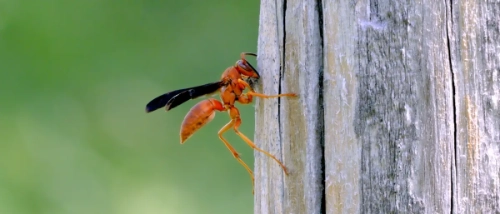
Red paper wasps comprise two closely related species: Polistes carolina and Polistes rubiginosus. Both species belong to the family Vespidae and are classified as paper wasps due to their distinctive nest-building behavior. They are named for the reddish-brown coloration of their head and body.

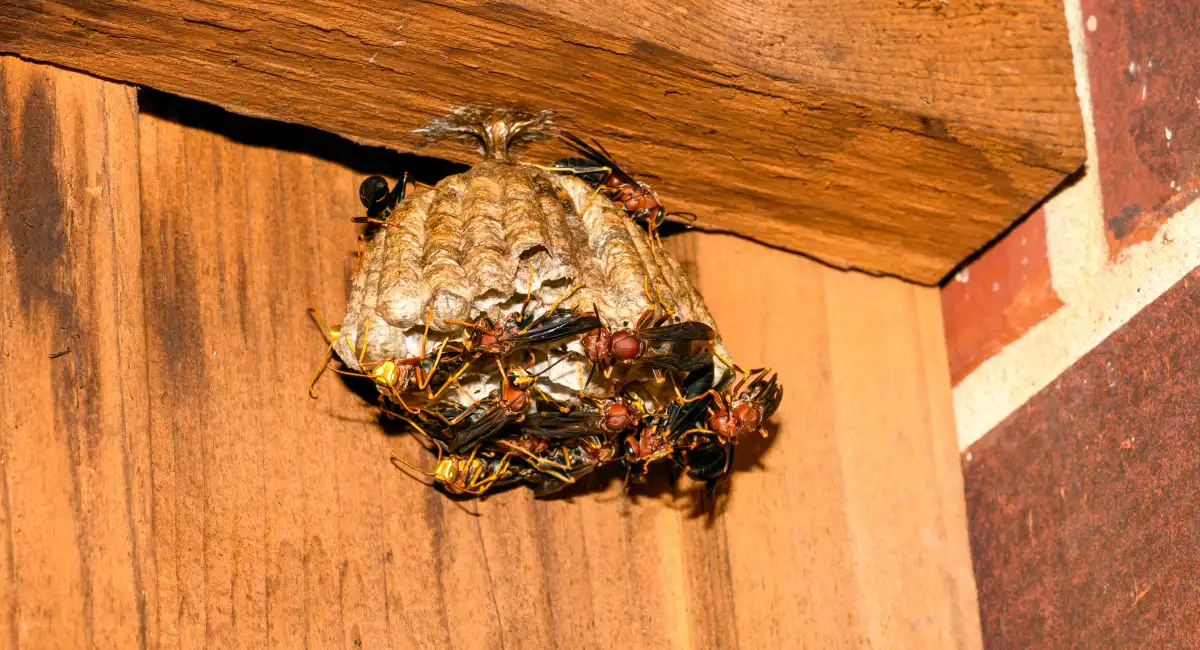
These social insects construct their nests by chewing plant and wood fibers mixed with saliva to create a paper-like material. When dried, their nests form characteristic upside-down umbrella or dome shapes with exposed honeycomb-like cells opening at the bottom.

 A red paper wasp, Polistes carolina, alighting on a fence post

Quick facts about red paper wasps

  • Size: Adults measure approximately 1 to 1.25 inches in length
  • Color: Distinctive reddish-brown to rust-colored bodies with black wings
  • Lifespan: The average workers lives from 12-22 days, though some live for 3-4 months; queens can survive up to a year
  • Distribution: Found in central, eastern and southeastern states.
  • Nest: Paper-like nests constructed from wood fibers and saliva, typically umbrella-shaped with exposed cells
  • Diet: Adults feed on nectar; larvae are fed caterpillars and other insect prey
  • Behavior: Social insects living in colonies; generally not aggressive unless threatened

Habitat, diet, life cycle, and behaviors

Learn where red paper wasps live, what they eat, and how they differ from other wasp species.

Red paper wasps are native to the eastern and south-central United States. They thrive in various habitats, from woodlands to suburban and urban environments. This adaptability means encounters with humans are quite common.

Red paper wasps prefer to nest in protected spaces that offer shelter from the elements. In natural settings, they commonly build nests in hollow trees, tree cavities, and dense vegetation. However, they frequently nest near human structures, taking advantage of man-made shelters such as the underside of roof eaves, bridges, chimneys, porches, and inside storage buildings or sheds.

Red paper wasps on a small nest suspended from a fence
A red paper wasp nest suspended from a fence

Adults primarily feed on nectar from flowers, making them occasional pollinators that can benefit gardens and crops. However, red paper wasps are also predators. They hunt caterpillars, beetle larvae, and other soft-bodied insects, which they chew into compact food balls to feed their developing larvae.

The red paper wasp colony cycle involves four overlapping phases throughout the year:

  1. The founding phase begins in spring when young reproductive females, known as foundresses,  emerge from overwintering sites. During this period, they establish dominance hierarchies, with the first to arrive at a nest typically becoming the queen.
  2. The worker phase follows as the first generation of workers emerges. These workers assume colony tasks including nest maintenance, foraging for food, and caring for larvae.
  3. The reproductive phase lasts from the emergence of the first reproductives until the colony begins to decline. During this time, the queen and subordinate foundresses lay eggs, with the dominant foundress producing the majority of offspring. Each foundress mates only once, storing sperm to fertilize eggs throughout the season.
  4. The intermediate phase occurs between colony decline and the founding of new colonies. The original foundresses often disappear as males accumulate in the nest and new reproductive females prepare to overwinter and start the cycle again the following spring.

Red paper wasps are social insects that live in colonies with clear hierarchical structures. The dominant foundress, or queen, gains the most reproductive success, though subordinate foundresses also contribute to egg-laying. Interestingly, the queen is not necessarily the largest female—rather, the first foundress to arrive at a nest typically becomes dominant.

These wasps demonstrate relatively low aggression compared to other stinging insects. However, when defending their colony, female workers can deliver painful stings. Unlike bees, red paper wasps can sting multiple times without dying.

Overwintering red wasps

One of the most common times homeowners and business owners encounter red paper wasps is during the fall and winter months. As temperatures drop in late summer and fall, mated female wasps begin searching for protected spaces to be used as overwintering sites where they can survive through the colder months. 

These young queens test properties by swarming around the warmer sides of buildings, looking for small gaps, cracks, and crevices large enough to squeeze into. They're not looking to build nests or establish colonies during this time—they simply need temporary shelter from the approaching cold, wet weather. Common overwintering sites include:

  • Cracks and crevices in building exteriors
  • Wall voids and attic spaces
  • Behind shutters and siding
  • Gaps around windows and doors
  • Hollow trees and protected outdoor structures

While in their overwintering state, red paper wasps become sluggish and are not typically aggressive. However, their presence can still be concerning for property owners. The good news is that overwintering is temporary. Once the first or second cold snap of the season arrives, wasps that didn't find adequate shelter will die off, and those that did will enter a hibernation-like state. In spring, surviving queens will emerge and fly away to establish new nests elsewhere. Red paper wasps do not reuse old nests, so they're unlikely to return to the same overwintering site year after year.

For businesses and facilities managers, understanding this seasonal behavior is important for planning pest management strategies. If you're experiencing issues with overwintering wasps, our team can help assess your property and recommend appropriate wasp control measures.
Managing red paper wasps

If you notice a wasp nest on your property, do not attempt to remove it yourself. Disturbing a nest can provoke defensive behavior and result in multiple painful stings. Professional wasp control services offer the safest and most effective solution for managing red paper wasps. 

At Presto-X, our trained technicians understand wasp behavior and use appropriate protective equipment to safely remove nests. Contact us today to schedule a free inspection.

Frequently asked questions

Red paper wasps are not naturally aggressive and typically only sting when they or their nest feel threatened. However, their stings can be painful and may cause allergic reactions in sensitive individuals.

No, red paper wasps do not reuse old nests. Once a colony declines in fall, the nest is abandoned. New queens that survive the winter will build entirely new nests in the spring.

Red paper wasp colonies are active from spring through early fall. As temperatures drop, the colony naturally declines and the nest is abandoned. Only mated queens survive the winter to start new colonies the following spring.

Red paper wasps are attracted to properties that offer protected nesting sites, such as eaves, overhangs, and sheltered structures. They're also drawn to areas with flowering plants (for nectar) and gardens with caterpillars and other insects (for feeding their larvae).

Book a free inspection with a technician local to your area.

Wasp and bee control for commercial premises.